Antony C. Black
Global Research
29 December 2017
Following the meltdown of the global economy in 2008/9 it was almost inevitable that the capitalist elite who had engineered the crisis would place, not merely the burden of paying for, but the ideological blame for the crisis on its victims.
Not all has gone the capitalists’ way however. Capitalism has, for example, come under concerted attack from varied and sundry sources as has not happened in almost a century. Thus, whether they arise from concerns for economic justice or ecological survival, from an interest in ‘radical democracy’ or in anti-imperialism, critiques of capitalism are back on the menu. Good stuff.
Still, many of these critiques, well-meaning and intentioned though they be, suffer – not invariably, you understand, but often enough to warrant deep concern – from a certain, how to say, befuddlement. One need only witness, for instance, the plethora of qualifiers on the subject to get a sense of the affliction: ‘corporate capitalism’, ‘disaster capitalism’, ‘predatory capitalism’, ‘financial capitalism’, ‘free market capitalism’, ‘rentier capitalism’, ‘monopoly capitalism’, ‘classical capitalism’ etc.
Now in casting our analytical gaze upon these adjectival qualifiers I submit that we are engaging in something rather more than a mere grammatical cavil. It may be true that some of the authors routinely employing these terms understand that what they are doing is simply bringing into bold relief a particular structural or historical aspect of capitalism. All well and good. But there is evidence to suggest that, much of the time, this is exactly not what is going on; that in fact what is going on is a barely veiled ideological ‘reformism’.
The latter term references the notion that capitalism is not in its essence bad, just that some variants of it are. Thus, if only we could, say, get back to ‘classical capitalism’ (a mythical time when capitalists supposedly understood what a ‘free market’ really was) then all would be well. Or perhaps, if we could just rid ourselves of ‘financial capitalism’, then we could all return to a regulated, productive, and equitable capitalism. The Golden Age would then, as capitalist ideologues themselves constantly assure us, be just around the next corner.
But, of course, no it wouldn’t.
For where all these qualifying formulations miss the mark is in either forgetting or in failing utterly to grasp what the core of capitalism really consists.
And so, then, of what does it consist?
Without diving too deeply into the inky abyss of Das Kapital we may yet say that capitalism is founded, first and foremost, on exploitation and that this exploitation is fundamental. Which is to say that it is not merely a matter of a temporary systemic crisis demanding – all odes to the immanent Golden Age aside – forty year global ‘austerity programs’, but that the wringing of capitalist profits is situated precisely in the theft of workers’ labour, of their ‘surplus value’. Moreover, this theft, structured on the profit motive, is further enjoined and aggravated by competitive inter-capitalist rivalry leading to the ineluctable ‘tendency of the rate of profit to fall’.
Consequent upon the latter are protracted periods of open class warfare in the global capitalist centres, and economic (and military) imperialism targeting the capitalist periphery. Indeed, far from standing on its own two legs, capitalism has always depended upon ‘primitive accumulation’, i.e. on non-capitalist inputs such as stolen resources, slave labour and subjugated markets, for its survival. As Rosa Luxemburg noted, colonialism, far from being some mere historical starting point, is capitalism’s constant and necessary condition.
Second, we may say that capitalism, whatever we may grant to it as an ‘engine of wealth creation’, is an essentially irrational economic system geared not towards the maximization of material wealth in general (as is often implied), but merely towards the maximization of wealth in so far as it can be appropriated as private profit. Thus, the ‘crises of overproduction’ which so regularly afflict the system overproduce goods not from the perspective of need (to which the billions of impoverished and immiserated humans on this planet bear stark witness), nor even from the perspective of the technical means and limits available to production, but only from the perspective of the money-backed profit that can be extracted from them.
Third, at the heart of capitalism is the centralization and concentration of both wealth and power. In this sense capitalism is akin to an unstable dynamic system in physics, rather like a bicycle in motion. It either moves, i.e. expands – or fails. The capture of political power is then but a simple corollary of the concentration of wealth. Whence the myth of bourgeois liberalism that you can somehow have political democracy without economic democracy. And whence also the myth of reforming capitalism, an aspiration that founders on the rocks of capitalism’s revolutionary and expansionary dynamic, a dynamic that renders all such ‘reform’ both ephemeral and, ultimately, illusory.
And finally, this continual expansion, just by the by, also presumes global ecocide, a conclusion the mature Marx presciently realized was the only inevitable demise of the capitalist system. And the only thing standing in the way of that grim future, as he also realized, was / is the development of a class consciousness sufficient for capitalism’s replacement – not its reform – by a truly democratic, rationally planned political economy.
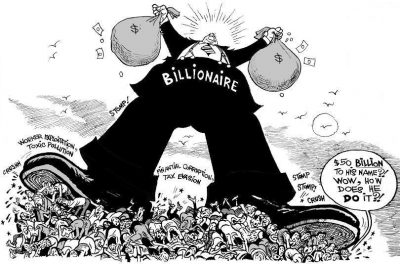
Featured image is from The Socialist Network.
Source: https://www.globalresearch.ca/capitalism-straight-up/5624307
Comments
Post a Comment